What Is Community Launch?
Community Launch is a free Skool community at skool.com/launchfree that teaches coaches, creators, and entrepreneurs how to build and monetize online communities — primarily on Skool. With 13,100+ members, 17 courses covering 120 modules, two recurring weekly live calls, and a sales script included at no cost, it sits toward the larger end of free communities on the Skool platform for this subject area.
This Community Launch review is written for anyone deciding whether Christian Crenshaw’s free training is worth their time — and whether the paid Community Launch Accelerator represents a logical next step. Those two decisions are related but distinct, and this review addresses both directly.
Community Launch is explicit about its two-tier structure. The free community delivers the team’s complete methodology for building and monetizing Skool communities through self-paced courses and group coaching calls. The paid Community Launch Accelerator, at $2,000 per month, provides done-with-you coaching for members who want personalized support beyond the group format. Both tiers use the same framework — the free content is not diluted to drive upgrades. Understanding that architecture upfront is essential to evaluating what you’re actually getting and what the community is designed to guide you toward.
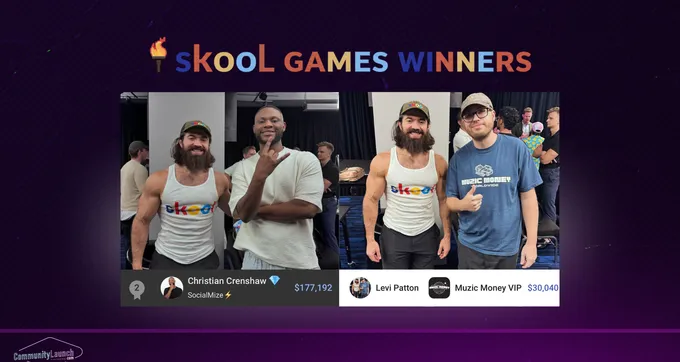
The most concrete credential the community leads with is its Skool Games track record. The Skool Games is a monthly community-growth competition run by Alex Hormozi and Sam Ovens that recognizes the fastest-growing Skool communities each month. Crenshaw’s team has won it three times. In a niche saturated with unverifiable income claims and coached testimonials, that kind of record is a different category of evidence — winning the Skool Games requires building actual community growth, not reporting it. It’s the right starting point for evaluating what this community is actually capable of teaching.
The community addresses three specific situations: starting a Skool community with no existing foundation, accelerating growth on a community that has stalled, and converting existing members into paying customers. The curriculum is organized around those three phases in sequence, which means the content is more coherently structured than many free Skool communities that aggregate loosely related material.
Who Built Community Launch
Christian Crenshaw’s Background
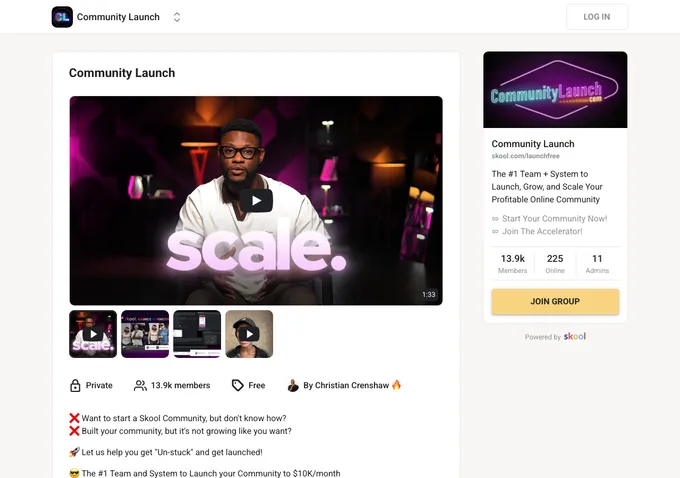
Christian Crenshaw is the CEO of CommunityLaunch.com and founder of SocialMize, based in the Atlanta metropolitan area. His professional history before building Community Launch spans more than a decade of marketing roles with increasing organizational scope — a profile more institutional than the typical Skool educator.
His LinkedIn profile documents 13+ years of marketing experience. At the CDC Foundation, Crenshaw led a $2M contract initiative for the CDC/NAACP Atlanta and ran a digital marketing campaign addressing COVID vaccination misinformation — work he credits with increasing the NAACP Atlanta’s annual budget by 500%. Before that, he spent 11 months as Media Manager at Scotts Miracle-Gro. Earlier still, he founded Clean Boy Promotions, a Nashville events and promotions startup he ran for seven years, generating $850K gross profit, managing teams of up to 100 people, and growing to 250,000+ social followers. He holds a Certified ScrumMaster credential and previously held a Project Management Professional (PMP) certification, which expired in 2023. He joined Skool in August 2023.
Crenshaw’s professional record spans a CDC Foundation initiative backed by a $2M contract, a Fortune 500 media management role at Scotts Miracle-Gro, and seven years running an independent events business — a background that sets him apart from most Skool educators whose credentials are built primarily within the Skool ecosystem itself.
The revenue claims Crenshaw makes — “$11.5M generated for clients,” “400+ creators helped,” “members consistently achieve $100,000+ months” — appear on creator-controlled platforms and are not independently verified in third-party sources. These should be read as marketing framing rather than audited results. What is corroborated across multiple independent sources is the Skool Games record: three wins for the team and claims of helping 12+ additional members win, referenced consistently across the official community page, the paid Accelerator page, and supporting research sources.
Crenshaw also maintains an external content presence beyond the community itself. He has appeared on outside podcasts discussing the mechanics of building a profitable Skool community — establishing that his methods attract interest beyond his own membership, not only from people he has already converted into students.
What the Free Curriculum Includes
The free Community Launch curriculum delivers more structured content than many paid Skool programs in this price range — an observation that’s more striking the longer you look at what the free tier actually includes.
The 17-course, 120-module Masterclass is organized around the community lifecycle: launching from zero, growing organically without paid ads, converting the audience into paying customers, and competing in the Skool Games for accelerated visibility. That sequencing means the curriculum is designed to take someone from concept to monetized community in a structured progression rather than offering a collection of standalone modules.
The community about page attributes dollar values to the four main content packages: the Community Launch Masterclass ($2,500 claimed value), Weekly Mastermind Calls with Skool Games Winners ($3,000 claimed value per year), Weekly Organic Marketing Strategy Sessions ($2,000 claimed value per year), and the 8-Figure Sales Script ($1,500 claimed value) — totaling $9,000 in stated value. These figures are from the community’s own marketing and aren’t independently validated, but the content categories themselves are confirmed across multiple research sources, and the structure is consistent with what SkoolRadar data shows.
The two recurring live call formats are what distinguish Community Launch from a static course library. The weekly mastermind calls feature coaches who have personally won the Skool Games — which means the strategies being discussed are competition-tested and recent, not inherited from older playbooks. The weekly organic marketing strategy sessions address a consistent gap in free business education: how to grow an audience without a paid advertising budget. Most free business content assumes you have one.
The teaching framework is called the “Automated Community Funnel” — Crenshaw’s system for attracting community members through organic content and converting them into paying customers across multiple price points. The funnel methodology has three stages: attention (drawing prospective members to your community through organic distribution), engagement (building the habit of participation inside the community), and conversion (moving engaged members into a paid product or membership tier). Free members receive genuine exposure to all three stages before they’re asked to make any financial decision about upgrading. That structural alignment is intentional: the free community functions as both a resource and a product demonstration.
SkoolRadar data shows 2,700+ posts accumulated in the community since its launch in 2024 — a signal of ongoing engagement rather than a burst of initial activity followed by inactivity.
Community Scale and What’s Verifiable
Community Launch at 13,100+ members, managed by an 11-admin team, operates at a scale uncommon for free Skool communities. Solo-creator free communities typically run with one or two moderators, and that ceiling becomes visible as membership grows — response times slow, thread quality degrades, and active members gradually disengage. An 11-person admin team represents a staffing investment that treats the free community as an operational responsibility rather than a low-effort funnel.
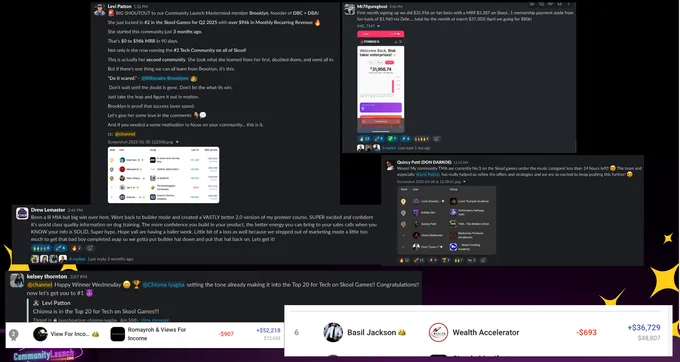
At the time of this research, 77 members were showing as online in the community simultaneously. For a free Skool community with 13,100+ total members, that level of real-time activity suggests a meaningful percentage of members engage regularly rather than joining and going quiet. Most free communities at this scale show lower active participation rates.
One data point worth surfacing: when Community Launch launched, it was positioned as free “until we reach 10,000 members.” When membership crossed that threshold, the stated limit was revised to 15,000 members. Whether this reflects a genuine future plan to introduce paid access or functions as a recurring growth incentive isn’t clear from available information. What it means for prospective members is that free access appears stable for the foreseeable future, but the community’s own language doesn’t commit to it permanently.
The community’s reputation outside its own ecosystem is currently unverifiable. No Trustpilot reviews, Reddit threads, forum discussions, or third-party editorial coverage appeared in research sources. This absence is typical for Skool communities that haven’t yet reached the age or media visibility to generate independent commentary — it’s a data gap, not a red flag. But it does mean any evaluation relies on structural signals (curriculum depth, admin team, live call frequency, Skool Games wins) rather than aggregated member feedback from outside the ecosystem.
Pricing: Free Access and the $2,000/Month Tier Above It
Community Launch operates on a freemium model with a significant price jump between its two tiers.
The free community at skool.com/launchfree provides full access to all 17 courses, both weekly live call formats, and the 8-Figure Sales Script at no cost. There’s no trial countdown, no credit card required, and no content gating within the free tier — everything inside the free community is accessible to all members from the moment they join.
The Community Launch Accelerator, at $2,000/month or $20,000/year, is application-gated: prospective members must book a qualification call before being admitted. The Accelerator adds two additional weekly coaching calls focused on tech support and marketing, two more weekly sessions with Skool Games winners, access to a customizable CRM system, and done-with-you coaching engagement rather than the self-directed model of the free community. The Accelerator has approximately 200 members — a stark contrast to the 13,100+ in the free tier, which keeps the paid program genuinely intimate.
For context on what the Skool Games credential actually means: participating in that competition requires a $99/month Skool Pro subscription just to be eligible. Alex Hormozi and Sam Ovens run the competition through Skool, and winning is determined by Skool’s own metrics for community growth, not by self-reporting. Community Launch’s three wins in that environment represent publicly verifiable achievement — the kind that’s difficult to manufacture through testimonials or marketing language. That competitive track record directly informs what’s being taught in both the free curriculum and the paid Accelerator, since Crenshaw’s team is applying the same methodology they used to win.
At $2,000/month, the Accelerator sits at the premium end of Skool community coaching programs. Comparable Skool coaching communities in the $97–$497/month range offer structured content and group calls at a fraction of the cost; the Accelerator’s price premium needs to be justified by the personalized coaching layer and direct access to coaches with verified Skool Games results. The free community explicitly functions as a lead funnel toward that upgrade — both things are true simultaneously, and the dynamic is more visible than many freemium models. Prospective members who engage seriously with the free content, attend weekly calls, and find the methodology compelling will inevitably encounter a path toward the paid tier. That’s worth knowing going in.
Who Should Join Community Launch
- You want to build a Skool community from scratch and prefer a structured 17-course, 120-module curriculum you can work through for free before committing any money.
- You want live coaching access from coaches with a documented Skool Games track record — Community Launch includes two recurring weekly call formats at zero cost, covering both mastermind strategy and organic community growth.
- You're considering the $2,000/month Community Launch Accelerator and want to evaluate the actual teaching methods, content quality, and team dynamics before making that financial commitment.
- You need third-party validation before joining — no Trustpilot reviews, Reddit discussions, or independent case studies for Community Launch appear in available research sources.
- You're building your community on Circle.so, Mighty Networks, or any non-Skool platform — the curriculum is Skool-specific, and the organic growth and monetization strategies are optimized for Skool's mechanics.
- Self-directed group learning isn't enough for your current needs — the free community offers courses and group calls, not 1-on-1 or personalized coaching; done-with-you support starts at $2,000/month in the Accelerator.
Community Launch is particularly well-suited to Skool community builders who are starting from zero or stuck at low membership counts without a clear organic growth path. The organic marketing emphasis addresses a real gap — most free business education in this space assumes ad budget access, and this curriculum explicitly doesn’t. If you’re working with limited paid-distribution resources and want to grow through content and community mechanics, the weekly organic marketing strategy sessions are probably the most immediately applicable element of the free tier.
Members who already have established communities with working growth systems and a functioning monetization model will find less actionable material here. The curriculum is oriented toward the earlier phases of the community-building journey. Similarly, members building outside the Skool ecosystem should look elsewhere: the content is platform-specific in ways that don’t transfer cleanly to Circle.so, Kajabi, or other community platforms. The Automated Community Funnel framework is calibrated around Skool’s leaderboard mechanics, gamification features, and Skool Games structure — remove the Skool context and the strategic specificity loses most of its value.
The Accelerator decision deserves its own separate evaluation after you’ve spent time in the free community. At $2,000 per month, the paid tier makes the most sense for a member who has a community in motion and a realistic line of sight to revenue that would offset the coaching cost. Joining the Accelerator cold, without first testing whether the free methodology resonates with how you work, is the higher-risk path.
The Bottom Line
Community Launch delivers a substantive free resource for Skool community building: 17 courses covering 120 modules, two weekly live call formats with coaches who have won the Skool Games, an 8-Figure Sales Script, and a 13,100+ member community managed by an 11-admin team — all at no cost. The three Skool Games wins are the community’s strongest independent credential, because winning requires actual community growth measured by Skool’s own leaderboard, not self-reported outcomes.
This Community Launch review finds the free tier earns a Recommended verdict for coaches, creators, and entrepreneurs seriously evaluating Skool community building as a business path. The value-to-cost equation for the free community is difficult to argue with: the curriculum is structured, the live call frequency is high for a no-cost offering, and the teaching methodology connects to a verifiable track record. There is limited downside to joining and assessing the content firsthand.
The caveats are real and worth naming clearly: headline revenue claims ($11.5M generated, 400+ creators helped) are self-reported without independent verification, no external member testimonials turned up in available research, and the free community is explicitly designed as a lead funnel for the $2,000/month Accelerator. None of these factors materially change the value of the free tier itself — they provide context for evaluating the broader ecosystem rather than reasons to avoid joining. A free community that teaches a verifiable methodology, maintains weekly live calls, and uses an 11-person admin team to manage 13,100+ members is offering something meaningful, regardless of whether the headline revenue figures hold up to scrutiny.
The more consequential decisions come later — whether $2,000/month for the Accelerator fits your timeline and budget, and whether the self-reported outcome claims align with what independent research would eventually surface. Those are upgrade-decision questions, best answered after spending time in the free community and forming a direct view of the material. Start there.
Pros & Cons
What We Like
- 100% free membership with no subscription fee, delivering 17 courses, 120 modules, weekly mastermind calls, and a sales script — substantial content access at zero cost.
- Team of coaches has won the Skool Games competition three times and helped 12+ additional members win, providing concrete evidence of community-building results.
- 11-admin team actively managing 13,000+ members provides broader support coverage than solo-creator free communities.
- Weekly live calls — both mastermind sessions and organic marketing strategy — add a coaching layer typically reserved for paid programs.
- Free community uses the same methods and tools taught in the $2,000/month Accelerator, giving members a genuine sample of the paid program before upgrading.
What Could Improve
- Revenue and client success figures ($11.5M generated, 400+ creators helped) are self-reported with no independent third-party verification found in available research.
- Free community is structured as a lead funnel for the $2,000/month Community Launch Accelerator — members may encounter promotion toward the paid upgrade.
- No independent reputation data found: no Trustpilot reviews, Reddit discussions, or third-party coverage in available research sources.
- Pricing for the paid Accelerator tier ($2,000/month) is high relative to comparable Skool coaching programs, per category comparisons.
Pricing
Community Launch (Free)
Free
- Community Launch Masterclass — 17 courses, 120 modules
- Weekly Mastermind Call with Skool Games Winners
- Weekly Organic Marketing Strategy Sessions
- 8-Figure Sales Script
- Access to 13,000+ member community and 11-admin team
- Skool Games strategy content and win playbooks
Community Launch Accelerator
$2,000/mo
- Everything in the free community
- Two additional weekly coaching calls (tech and marketing support)
- Two weekly calls with Skool Games Winners
- Fully Customizable CRM (or access to CRM snapshot)
- Community Optimization Checklist
- Community Launch Bootcamp access
- Application-gated — qualification call required
Community Launch Accelerator (Annual)
$20,000/year
- All Accelerator monthly features at annual billing
- Application-gated — qualification call required
Frequently Asked Questions
Is Community Launch really free to join?
Who is Christian Crenshaw and what qualifies him to teach community building?
What does Community Launch include for free members?
Who is Community Launch best suited for?
How does Community Launch compare to the paid Community Launch Accelerator?
Ready to join Community Launch?
Starting from Free
Similar Money Communities
The Trading Cafe
Free Skool community offering structured forex and stock trading education through 263 course module
Read ReviewCurso Skool Gratis
Free Spanish-language Skool community teaching coaches, infoproduct creators, agencies, and local bu
Read ReviewThe Founders Club
Free Skool community by Ibrahim Ansari for entrepreneurs and digital builders focused on AI automati
Read ReviewWholesaling Real Estate
A free Skool community of 76,000+ members teaching real estate wholesaling from scratch, with a gami
Read ReviewThe Vault
Free Skool community offering structured education in stocks, options, and futures trading through f
Read ReviewAbout the Creator
Christian Crenshaw
Founder & CEO
CEO of CommunityLaunch.com and founder of SocialMize, based in Atlanta. Christian Crenshaw has 13+ years of marketing experience including leading a $2M CDC Foundation contract initiative and working as Media Manager at Scotts Miracle-Gro. He developed the Automated Community Funnel framework and his team has won the Skool Games competition three times while claiming to have helped 12+ additional members win. Revenue figures he cites ($11.5M generated for clients, 400+ creators helped) are self-reported and not independently verified in third-party sources.