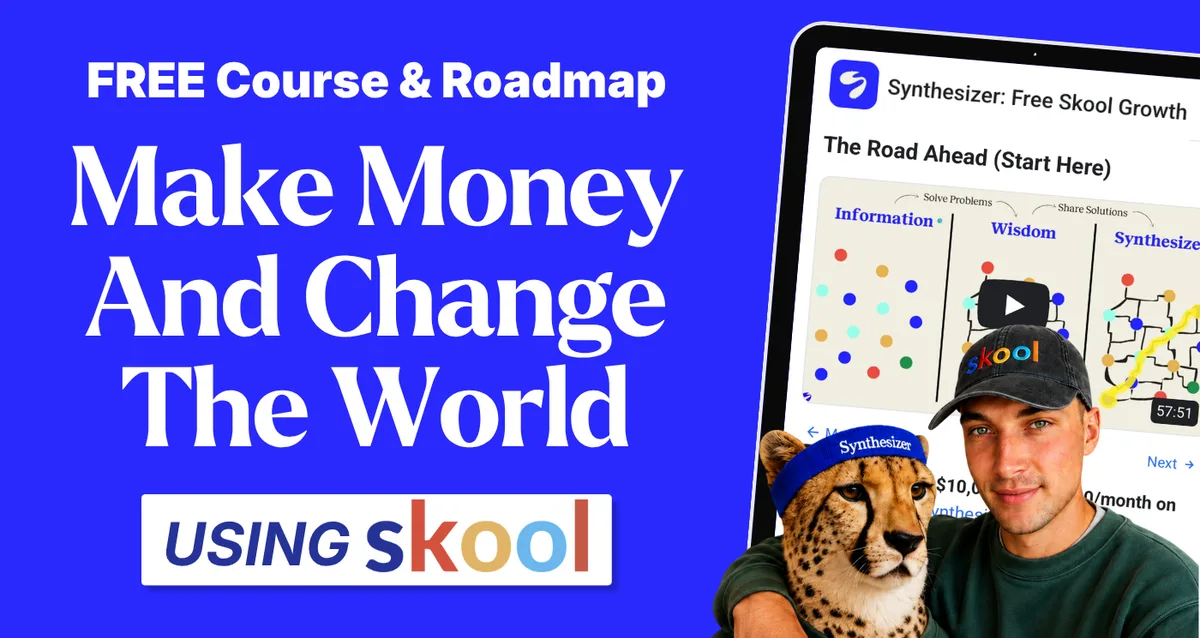
One of Skool’s Largest Free Communities for Educational Creators
Synthesizer is a free Skool community with 42,000+ members, built by YouTuber Andrew Kirby and co-host Aidan LaBreche to help educational creators grow and monetize their own Skool groups. It packages the Synthesizer Roadmap course (the founder values it at $999), weekly live Skool Growth coaching calls, and a working peer network into a $0 membership. That combination has made it one of the larger free communities on the platform in the money category.
This synthesizer skool review looks at what the free tier actually contains, how the community operates day to day, and where the interesting friction is: a separately-branded paid mentorship tier that Kirby funnels members toward, without a publicly disclosed price.
Synthesizer’s free tier is genuinely substantial: a full course, live weekly coaching, and a 42,000-member peer network at zero cost. The trade-off worth understanding upfront is that the community also acts as an on-ramp for a paid mentorship whose pricing is not published.
The Creator Behind Synthesizer: Andrew Kirby and Aidan LaBreche
Andrew Kirby is a UK-based YouTuber whose channel sits somewhere in the 500,000 to 600,000 subscriber range (exact figures vary across snapshots taken the same week). He publicly describes himself as Skool’s “first investor” and the founder of “the first free Skool community,” though both claims are superlatives without independent corroboration. What is verifiable: he shows up regularly on Skool’s own promotional programming and hosts weekly calls inside Synthesizer itself.
Kirby’s day-to-day partner is Aidan LaBreche, a Canada-based educator who acts as the community’s operator and co-host. LaBreche handles more of the direct member interaction, which matters when 42,000 people share a space; a solo-creator community at that scale tends to feel abandoned quickly, and the two-person operating model is one reason Synthesizer does not.
There is one piece of Kirby’s background that the Skool about page does not mention. Before Synthesizer, he built and ran TimeTheory, a procrastination-coaching program that sold at $2,800 (or $1,400 for students). TimeTheory is no longer accepting new applicants, and available sourcing indicates Kirby’s focus has shifted fully to Skool. A critical third-party writeup at gripeo.com alleged high-pressure sales tactics in that program and questioned Kirby’s credentials for coaching people with procrastination struggles. That commentary is about TimeTheory specifically, not Synthesizer, but it is relevant context because Synthesizer’s paid tier uses a structurally similar model: free value, then a sales conversation, then a high-ticket close.
None of this is disqualifying. It is useful to know before joining any funnel-shaped community.
What Members Actually Get: The Roadmap Course, Weekly Calls, and a Peer Network
The core deliverables are three: the Synthesizer Roadmap course, weekly live Skool Growth coaching calls, and general community access.
The Roadmap teaches a “Consume, Curate, Create” content framework aimed at educational creators trying to grow and monetize a Skool group. The framework is deliberately simple: absorb reference material, filter it for what your audience needs, and produce content on a repeatable cadence. Independent commentary describes it as effective for reducing overwhelm in beginners who otherwise stall on “what should I make.” A full module list is not visible on the about page, so members see the complete curriculum after joining.
The weekly calls are the more distinctive piece. Live coaching every week, hosted by Kirby and LaBreche, gives members a recurring touchpoint that a static course library cannot replicate. This is where a free community can either deliver real ongoing value or coast on the initial course; based on the community’s platform ranking and posting patterns (covered in the next section), the calls appear to run consistently.
One independent observation from a member who wrote publicly about the experience: roughly 95% of members had not completed the free courses inside the community. That number sounds alarming, but it reflects a pattern common to every large free community: most people join, browse the room, and never work through the material. It is not evidence that the course is bad. It is evidence that “free” and “completed” almost never overlap at scale. For a serious member, this is arguably good news: less competition for the founder’s attention on live calls.
Community Experience: What 42,000 Members Feels Like Day to Day
Synthesizer sits in the top 1% of Skool communities by platform ranking, which is not a purely cosmetic metric on Skool. The ranking blends engagement and retention signals, so a community at this size and this rank is genuinely being used, not just being joined.
The tone in the community, according to an independent Substack review, is action-oriented and encouraging. The reviewer described a “Start then Learn” culture that pushes members to publish quickly rather than perfect their offerings before shipping.
An awesome community with motivated people who build each other up.
That framing matches the Consume, Curate, Create framework Kirby teaches. Both push members toward output over analysis. Whether that suits you depends on how you learn: if you thrive on external accountability and iteration, the environment is a good fit. If you prefer to study a curriculum end to end before touching a keyboard, the culture will feel too fast.
There is a notable absence in the reputation picture: no significant Reddit discussion about Synthesizer exists across targeted searches, despite the community’s size. That could mean the audience simply does not congregate on Reddit, or that organic third-party commentary is thin. Either way, most public commentary on Synthesizer comes from review sites (scamrisk.com, gripeo.com) whose entire business model is generating “is X legit” content, which is a limit on independent signal, not a disqualifier.
Pricing: What Free Costs, and What the Paid Tier Might Cost
The community itself is free. Genuinely free. $0 to join, $0 for the Roadmap course, $0 for the weekly coaching calls.
The pricing conversation gets more interesting one level up. Two related-but-separately-branded Skool communities exist under Kirby’s operation: skool.com/synthesizers (“High-Ticket Synthesizer School”) and skool.com/scaler (“Synthesizer Scaling”). These are paid mentorship offerings, and neither publicly lists a price. A third-party review at scamrisk.com estimates the mentorship falls somewhere in the $7,000 to $12,000 range based on comparable high-ticket creator-coaching offers, but this figure is an inference, not a confirmed number.
The transparency gap here is real. The keyword “synthesizer skool price” gets meaningful monthly search volume, which strongly suggests prospective members are hunting for information Kirby’s public materials do not provide. Any honest synthesizer skool review has to name that gap clearly. If you go through the free tier and get invited to a paid conversation, ask for the price and refund terms in writing before agreeing to anything.
By comparison, Skoolers, the largest direct free competitor in this exact niche, has roughly 164,700 members and is run by the Skool platform itself rather than an independent creator. It offers platform-official guidance without a paid upsell. Many creators join both, using Skoolers for platform-official best practices and Synthesizer for the more community-driven, creator-focused approach. On the paid side, School of Mentors sits at around $30 per month for a mentorship-focused peer group at much smaller scale (roughly 6,200 members).
The right way to think about Synthesizer’s economics: the free tier is genuinely a good deal, and the paid tier is opaque enough that you should treat any conversation about it as an early sales call, not a shopping experience.
Who Should Join Synthesizer
Synthesizer works best for a specific kind of creator.
If you are already publishing on YouTube or an adjacent platform and want to build a Skool community that monetizes your audience, the Roadmap course and weekly calls are directly aimed at your situation. The Consume, Curate, Create framework gives you a repeatable content system, and the peer network gives you 42,000 other creators at various stages to trade notes with. At $0, the cost of trying it is essentially your time.
If you are earlier in the journey (still choosing a niche, still building an audience), the community is a low-risk place to observe how creators one or two steps ahead of you operate. You will not extract the same value as a member with a working audience, but the price is right and the environment is action-oriented enough to keep you moving forward instead of stuck in research mode.
The community is a weaker fit in three situations. If you are exploring Skool as a hobby with no intention of building a monetized community, the free tier is fine to browse but nothing else in the ecosystem is aimed at you. If you dislike sales funnels and would be uncomfortable receiving a pitch for a paid mentorship whose price is not published, factor that in. And if you learn best from independent third-party validation (Trustpilot reviews, Reddit threads, verified case studies), you will find the evidence base thinner than the community’s size would suggest.
- You are actively building a Skool community and want a structured content framework plus weekly live coaching from creators who have grown their own audiences on the platform.
- You already have or are building an audience elsewhere (YouTube, newsletter, social) and want a peer network of 42,000 educational creators to test ideas against at zero cost.
- You value an action-oriented culture that pushes you to publish quickly and iterate, rather than a slower, curriculum-first environment where you study before shipping anything.
- You are researching Skool as a general concept without a concrete plan to build a community, in which case the free platform-official Skoolers community is a lower-friction starting point for orientation.
- You would be uncomfortable being funneled toward a paid mentorship whose price is not publicly disclosed, and you prefer paying upfront for a program with published pricing and refund terms.
- You rely heavily on independent reviews and public case studies before joining a community, and the thin third-party commentary on Synthesizer is a genuine dealbreaker for you.
If Synthesizer is not the right fit, other options in the best money communities on Skool hub cover adjacent needs: platform-official guidance at Skoolers, mentorship-focused peer groups at School of Mentors, and broader business-building communities at higher price points.
The Bottom Line on Synthesizer
Synthesizer earns a Recommended verdict.
The single strongest thing about it is the value density of the free tier. A structured course, weekly live coaching from active creators, and access to a 42,000-member peer network at zero cost is an unusually generous offering in a category where equivalent programs routinely run $50 to $150 per month. Combined with a top-1% platform ranking that suggests real engagement rather than signup churn, the free tier delivers what it promises.
The single most important caveat is the undisclosed pricing on the paid mentorship tier that free members are funneled toward. That is a transparency gap worth naming clearly, and it is why this synthesizer skool review pushes back on treating any conversation about the paid tier as a shopping experience. If you enter that conversation, ask for the price and refund terms in writing before you commit.
For creators actively building a Skool community, Synthesizer is a low-risk, high-value place to start. Join the free tier, work through the Roadmap course, show up to a few live calls, and see whether the culture and coaching fit your working style. At $0, that is a genuinely good deal.
Pros & Cons
What We Like
- Free entry to a full course (self-valued at $999), weekly live coaching calls, and a peer network of roughly 42,000 creators, an unusually substantial free offering in the money category.
- One of the larger free communities on the Skool platform, holding a top-1% platform ranking, which suggests real engagement and retention rather than a signup-and-forget pattern.
- Real day-to-day operator presence, with Aidan LaBreche handling the community host role and Andrew Kirby active on YouTube with a 500,000 to 600,000 subscriber following.
- The Consume, Curate, Create framework gives creators a repeatable structure to work from, distinct from a scattered YouTube-tutorial approach to Skool growth.
What Could Improve
- A separate paid mentorship tier under related community names (synthesizers, scaler) is funneled to free members without publicly disclosed pricing, which independent reviewers describe as a transparency gap.
- An independent Substack reviewer observed that roughly 95% of members had not completed the free courses offered inside the community.
- Founder credibility signals such as revenue and audience figures are largely self-reported and vary across sources, so specific dollar or follower claims should be treated as approximate rather than audited.
- A prior program by the same creator, TimeTheory, drew critical third-party writeups alleging high-pressure sales tactics, relevant context for the same free-value-to-sales-call funnel structure now used for Synthesizer's paid tier.
Pricing
Free
Free
- Synthesizer Roadmap course (self-valued at $999)
- Weekly live Skool Growth coaching calls
- Community discussion feed
- Access to a peer network of roughly 42,000 educational creators
- Consume, Curate, Create content framework
Frequently Asked Questions
Is Synthesizer Skool actually free to join?
What does the Synthesizer Roadmap course cover?
Is there a hidden or paid mentorship tier behind Synthesizer?
Is Synthesizer worth joining if the goal is to grow a Skool community?
How does Synthesizer compare to Skoolers, the official Skool community?
Who is Andrew Kirby and what is his background?
How many members are in Synthesizer and how active is the community?
Ready to join Synthesizer: Free Skool Growth?
Starting from Free
Similar Money Communities
The Trading Cafe
Free Skool community offering structured forex and stock trading education through 263 course module
Read ReviewCurso Skool Gratis
Free Spanish-language Skool community teaching coaches, infoproduct creators, agencies, and local bu
Read ReviewThe Founders Club
Free Skool community by Ibrahim Ansari for entrepreneurs and digital builders focused on AI automati
Read ReviewWholesaling Real Estate
A free Skool community of 76,000+ members teaching real estate wholesaling from scratch, with a gami
Read ReviewCommunity Launch
Free Skool community teaching coaches, creators, and entrepreneurs how to launch, grow, and monetize
Read ReviewAbout the Creator
Andrew Kirby
Founder
Andrew Kirby is a UK-based YouTuber with a following in the 500,000 to 600,000 subscriber range and describes himself as Skool's first investor. He co-runs Synthesizer with Aidan LaBreche, a Canada-based educator who serves as the community's day-to-day host and operator.